
Membership Discounts Applied at Checkout
PORE 2-1: Upscaling Theories and Multiscale modeling of flow and reactive transport in porous media
Join Michel Quintard, CNRS Research Director Emeritus at the Institute of Fluid Mechanics in Toulouse, France, for a course on "Upscaling Theories and Multiscale modeling of flow and reactive transport in porous media."
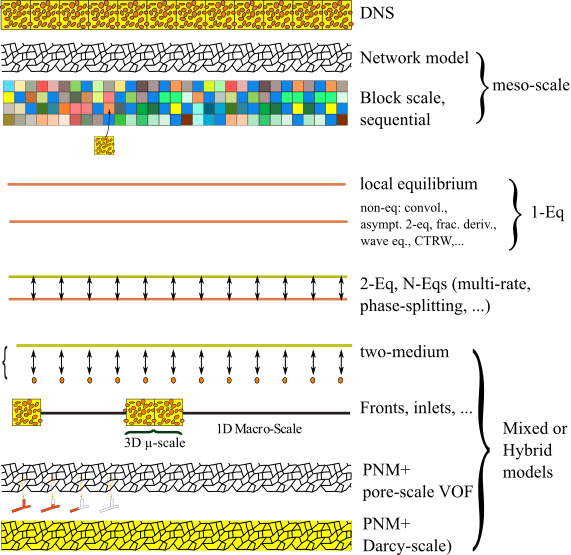
Porous media present a fundamental modeling challenge: their intricate structure spans multiple length and time scales, making direct simulation impractical for most applications. This complexity has driven the development of a rich landscape of approximate modeling approaches—from meso-scale methods like pore network models to fully macroscopic continuum descriptions, including hybrid formulations and phase-splitting techniques.
What Will You Learn?
- Understand the hierarchy of porous-media transport models and how major modeling frameworks relate to one another.
- Apply core mathematical foundations to fundamental transport problems such as single-phase flow, heat transfer, and reactive transport.
- Select appropriate modeling approaches for real-world applications across diverse fields
Course Dates & Time:
- Friday, June 19 8:00 - 11:00 (EU Central Time)
- Monday, June 22 8:00 - 11:00 (EU Central Time)
- Wednesday, June 24 8:00 - 11:00 (EU Central Time)
- Friday, June 26 8:00 - 11:00 (EU Central Time)
Michel Quintard has focused his research on all modeling aspects of multiphase, multicomponent, reactive transport in porous media, with emphasis on multi-scale phenomena. His contributions span from fundamental perspectives (upscaling theories, mixed-scale couplings, non-equilibrium models, effective boundary conditions) to a broad range of applications in petroleum engineering (double-porosity systems, non-Newtonian and viscoelastic flows, thermal recovery methods), environmental hydrogeology (NAPL transport, dissolution), nuclear engineering and safety, chemical engineering (flow in structured media, waste biodegradation, adsorption), heat transfer, superfluid flows, and biomechanics (biofilms, brain circulation, bone cancer).
This course provides a systematic introduction to the major modeling frameworks used in porous media transport analysis. Rather than treating these approaches in isolation, we emphasize the connections and hierarchies between them, helping students develop the insight needed to select appropriate models for specific applications. The “logo” figure of the lectures offers a visual roadmap through this diverse modeling landscape. Mathematical foundations are developed through core transport problems: single-phase flow, heat transfer, and reactive transport. Throughout the course, examples and case studies are drawn from diverse fields—chemical and reservoir engineering, nuclear reactor and waste management, subsurface hydrology, bioengineering, and materials science—illustrating how the same fundamental principles apply across applications.
By the end of this course, students will be equipped to navigate the modeling landscape confidently and make informed choices when confronting real-world transport problems in porous media.
Important note: All lectures will be offered live via Zoom, and participants are expected to attend all sessions in order to be granted a certificate of attendance. Recordings of the lectures will be provided in most cases within 24 hours after each session. These recordings will be available for 1 month following course completion. Please note that sharing the recordings with others is not permitted.
Please note that the Zoom link and all other course-related information will be made available within the individual lessons, which registered participants can access through their user account the week before the course start. For questions, please contact margaret.dieter@interpore.org.
Course Fees for 2026:
InterPore Society Members (Non-Members)
- Students: 120€ (150€)
- Academics: 180€ (220€)
- Industry: 240€ (360€)